Understanding the CASPer Exam: What It Is and How I Scored in the Highest 4th Quartile
Table of Contents
One part of the medical school application process that is not talked about enough is the CASPer exam.
CASPer stands for Computer-Based Assessment for Sampling Personal Characteristics. It is an online situational judgment test used by admissions committees for people-centered professions such as medicine, nursing, and teaching. Unlike the MCAT, which measures academic knowledge, the CASPer exam evaluates soft skills such as empathy, situational awareness, ethics, professionalism, and communication.
When I first heard about the CASPer exam, I honestly did not even know it was part of the application process until about a month before submitting my application. Because it is not discussed nearly as much as the MCAT or personal statements, I wanted to write this post to help demystify the exam.
Why Do Medical Schools Use CASPer?
Medicine is not just a scientific field—it is also a human-centered profession. Physicians are constantly faced with stressful situations, ethical dilemmas, interpersonal conflicts, and difficult decisions where there may not be one clear “right” answer.
The CASPer exam is designed to assess how applicants approach these situations. Rather than looking for a perfect answer, the test evaluates how you think through a problem, consider multiple perspectives, and communicate your reasoning.
Standardized tests like the MCAT can measure academic ability, but they do not necessarily measure judgment, professionalism, or interpersonal skills. CASPer attempts to fill that gap.
My CASPer Experience
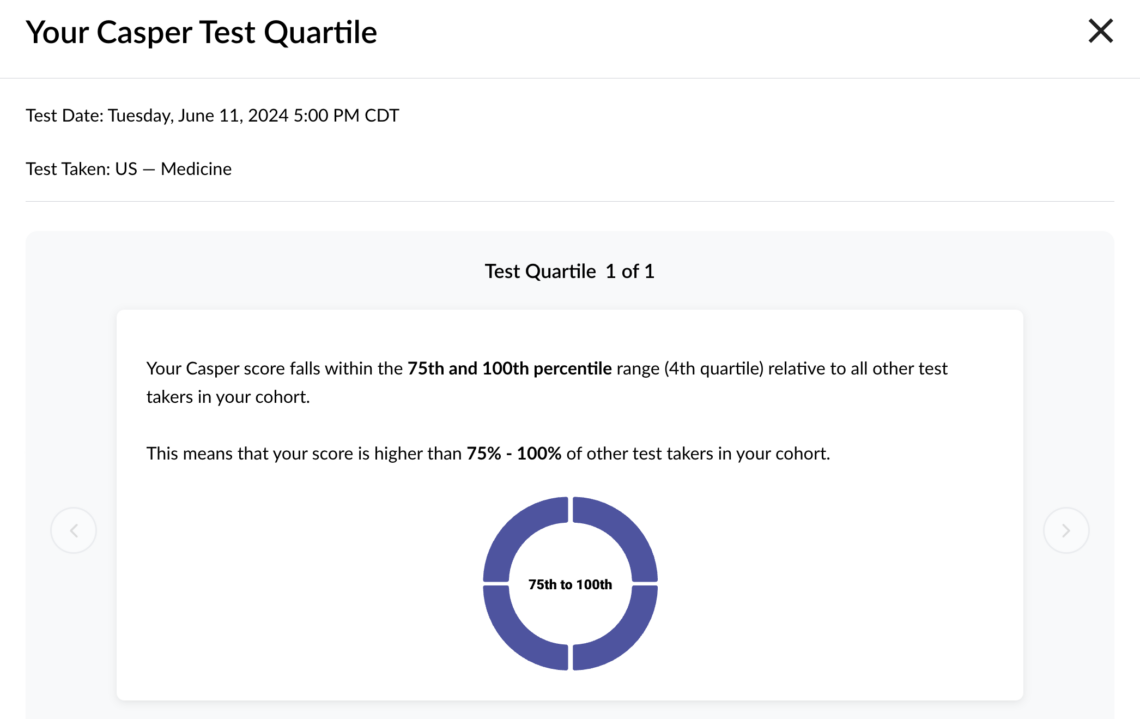
I took the CASPer exam during my application cycle and ultimately scored in the 4th quartile, which is the highest scoring category and places you in the top 25% of test takers.
The score report does not provide a numerical score. Instead, it places applicants into quartiles:
- 1st Quartile = Bottom 25%
- 2nd Quartile
- 3rd Quartile
- 4th Quartile = Top 25%
When I applied through TMDSAS, I submitted my primary application around the end of May. I then took the CASPer exam approximately two to three weeks later, around mid-June.
Looking back, I spent about three weeks preparing for the exam.
What Does the CASPer Exam Look Like?
The CASPer exam presents a series of hypothetical situations and dilemmas. These may involve workplace conflicts, ethical concerns, communication challenges, or other situations requiring judgment and professionalism.
For example, you might be asked about:
- A colleague who is cheating
- A conflict between coworkers
- A difficult customer interaction
- A social media professionalism issue
- Medical ethics scenarios

The exam is divided into two response formats:
Written Responses
Some scenarios require you to type responses to open-ended questions based on the situation presented.
Video Responses
Other scenarios require you to record video responses using your webcam. Typically, you are given about one minute to answer each question.
The entire exam takes approximately 100 minutes to complete and includes scheduled breaks.
My Advice for Preparing
One thing I want to emphasize is that you should not stress too much about the CASPer exam.
Compared to the MCAT, the preparation period is much shorter. I personally spent about two weeks preparing, and in hindsight, that was more than enough time.
The key is to use your preparation time efficiently.
The exam is not testing memorization. Instead, it is evaluating how you think through situations and communicate your reasoning. As long as you understand common ethical principles, professionalism, empathy, and conflict resolution strategies, you can perform very well.
For my subscribers, I will also be sharing the CASPer templates that I personally used to answer questions during my preparation. These templates helped me organize my thoughts and approach scenarios consistently throughout the exam.
If you’re interested, wait for the pop-up screen to appear and subscribe, or get re-directed to the “free pre-med resources” page by clicking here!
Sample CASPer Questions
Below are a few examples of the types of questions you may encounter.
Personal Reflection Example
Think of a time when you had to make a sacrifice in order to accomplish a goal.
- Briefly describe the situation and the sacrifice you made.
- Do you regret your decision to make the sacrifice? Why or why not?
- Did you learn anything from the situation that can be applied to your desired career? Explain your response.
Situational Scenario Example
You work at a retail store and a man is trying to return a toy without a receipt.
Your colleague explains that she cannot issue a refund without a receipt but offers store credit instead. The man claims he needs the money to fill a prescription for his sick daughter. Your colleague asks what she should do.
- As the store manager, would you give the customer a refund? Why or why not?
- If you decide to follow store policy, how could you refuse the refund in an appropriate manner?
Professionalism Scenario Example
A friend posts a photo on social media that includes confidential information visible in the background from a healthcare setting.
- What concerns do you have?
- How would you approach your friend?
- What should be done if they refuse to remove the post?
Additional Practice Resources
The examples above are only a small sample of the types of questions you may encounter.
When you subscribe, you will receive:
- Additional CASPer practice questions
- My personal CASPer response templates
- Preparation resources that helped me earn a 4th-quartile score
I hope this post helps make the CASPer exam feel a little less intimidating. While it may seem unfamiliar at first, remember that the goal is simply to demonstrate thoughtful decision-making, empathy, professionalism, and effective communication.